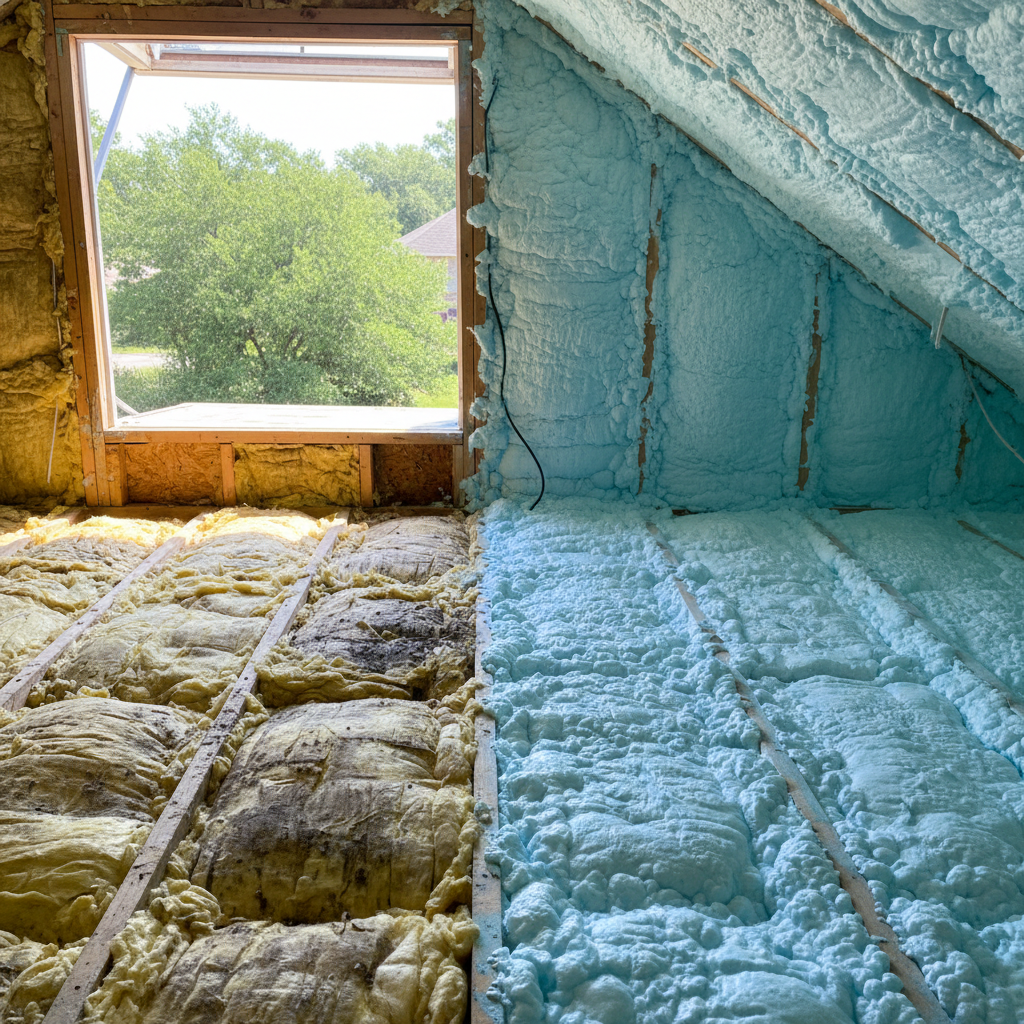
Alright, let's talk open-cell spray foam. It's a fantastic insulation choice, especially here in Texas, and a lot of folks in Arlington are looking into it. But when you decide to go with open-cell, you're usually faced with a pretty big decision: do you spray it on the attic floor, or do you spray it directly to the underside of your roof deck?
Both approaches use the same great open-cell foam, but they create totally different environments in your home. I've seen both done countless times across Arlington, from the older homes in Pantego to the newer builds near Viridian, and each has its pros and cons. Let's get into what you need to know.
Attic Floor Insulation: The Traditional Approach
This is probably what you picture when you think about insulating an attic. We're talking about spraying the open-cell foam directly onto the floor of your attic, right above your living space. It seals off your conditioned air from the unconditioned attic above.
- Cost: Generally, insulating the attic floor is less expensive upfront. You're covering a smaller surface area compared to the entire roof deck, so it requires less material and usually less labor. This can be a big factor for homeowners on a tighter budget.
- Durability & Maintenance: Once it's in, it's pretty durable. Open-cell foam isn't going anywhere. Maintenance is minimal; you just don't want to compress it or damage it. If you've got ductwork up there, though, it's still sitting in an unconditioned space, which means it's working harder and losing efficiency. You might also find your attic gets incredibly hot in the summer, like 140-150 degrees, which isn't great for anything stored up there or for any equipment like furnaces or water heaters.
- Appearance: It's an attic, so appearance usually isn't a huge concern. It looks like a big, fluffy, light-colored cloud covering your joists.
- Arlington Conditions: This method works, and it's definitely better than old, failing fiberglass. But with our scorching Arlington summers, that attic space still gets ridiculously hot. Your HVAC unit, if it's up there, is fighting a losing battle against that heat, and that means higher energy bills.
Roof Deck Insulation: Creating a Conditioned Attic
Now, this is where open-cell really shines, especially for a place like Arlington, TX. When you insulate the underside of your roof deck, you're essentially bringing your attic space into your home's conditioned envelope. The foam is sprayed directly onto the sheathing, sealing everything from the eaves to the ridge.
- Cost: This is almost always going to be more expensive upfront. You're covering a much larger surface area, and it often requires more prep work to make sure everything's sealed up tight. But think about the long-term savings.
- Durability & Maintenance: Extremely durable. The foam adheres directly to the roof deck, creating a continuous thermal barrier. The big win here is that your attic temperature drops significantly. We're talking maybe 85-95 degrees on a 100-degree day, not 150. This is huge for your HVAC system, ductwork, and anything you store up there. Your HVAC unit isn't working nearly as hard, which extends its life and reduces energy consumption. Plus, it can help prevent ice dams in the rare event we get significant snow and cold, though that's not a huge concern here.
- Appearance: Again, it's an attic, but it looks clean and uniform. The foam expands to fill every nook and cranny, so it's a very thorough seal.
- Arlington Conditions: This is my clear recommendation for most Arlington homeowners, especially with our intense heat and humidity. By bringing the attic into the conditioned space, you're not just insulating; you're creating a buffer zone. Your ducts aren't leaking conditioned air into a superheated oven, and your HVAC unit isn't constantly battling extreme temperatures. This translates directly into lower energy bills, a more comfortable home, and a longer lifespan for your HVAC system. It also helps with humidity control, which is a constant battle in North Texas.
Making Your Decision
So, which one is right for you? If your budget is super tight and you just need to get some decent insulation in, the attic floor option is a step up from nothing. It'll definitely improve your home's energy efficiency compared to old, worn-out insulation.
But if you're looking for the absolute best performance, maximum comfort, and long-term energy savings, insulating the roof deck with open-cell spray foam is the way to go. It's an investment, no doubt, but it pays dividends in comfort and reduced utility bills, especially when that Texas sun is beating down on your roof for months on end. I've seen homeowners in places like the Dalworthington Gardens area, with their older, less efficient homes, get incredible results from this approach.
For us at Arlington Spray Foam Insulation, we usually steer folks towards the roof deck application for open-cell whenever possible. It just makes so much more sense for our climate. You're not just insulating; you're fundamentally changing how your home deals with the heat and cold, making it a much more efficient and comfortable place to live.
Think about what you're trying to achieve. Is it just basic insulation, or are you looking to truly optimize your home's energy performance and comfort for the long haul? That's usually the deciding factor.
Final Thoughts
Either way you go, open-cell spray foam is a solid choice. It fills gaps, reduces air leakage, and offers great thermal performance. But by insulating the roof deck, you're tackling the heat load right at the source, creating a much more stable and efficient environment for your entire home. It's a game-changer for comfort and energy bills in our hot climate, and that's something you'll appreciate every single day.